


MADE IN: Crafts — Design Narratives Traveling Exhibition and Conference in Ljubljana
Share on


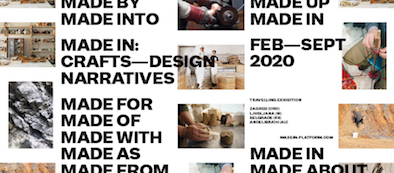
THE TRAVELING EXHIBITION MADE IN: CRAFTS — DESIGN NARRATIVES, is a result of two-year activities conducted by six partnering organizations: Museum of Arts and Crafts, OAZA (Croatia); Museum of Architecture and Design (Slovenia); Werkraum Bregenzerwald (Austria); Nova Iskra, Mikser (Serbia), within a larger MADE IN Platform initiative (www.madein-platform.com). The exhibition showcases the Crafts Archive of 40 craftspeople from the region through photo documentation and stories, and raises questions about the production in the contemporary world within eight Crafts — Design Narratives realized through collaborations of more than 30 craftspeople and more than 40 designers from all over Europe.
The premiere was scheduled for the 17th February 2020 in the Museum of Arts and Crafts in Zagreb. The exhibition opening was followed by Dialogues discursive program with project curators and participants on the 18th of February, at the Museum of Arts and Crafts in Zagreb. The exhibition will continue its traveling during 2020, to Ljubljana, Belgrade and Andelsbuch, with perspective to visit other European cities during 2021. The exhibition opening in Ljubljana is scheduled for Thursday, March 19th from 7 p.m. The exhibition opening will be preceded by the Conference entitled Design and Crafts in Dialogue #4, which is going to be organized from 10:30 a.m., also at the Museum for Architecture and Design.
MADE IN is a research, design and heritage platform that proposes new collaborative practices and knowledge exchange between the traditional craftspeople and contemporary designers. It engages craftspeople, designers, researchers, curators and theoreticians on a quest to pose relevant questions about the topics of heritage and production in today’s society through research and archiving of local crafts, conducting workshops and residencies and promoting ideas through a travelling exhibition.
WHY MADE IN?
The MADE IN syntagma in the title carries a reference to anonymous and to some extent non-human production of today, which is taking place in the countries of the Far East. It emphasizes the position of design within the current market oriented neo-liberal capitalist paradigm, with a reference to its source — craftsmanship and making, from which the discipline was inseparable up until the advent of industrialization. Today, on the brink of a technological revolution there seems to be a need to pose the questions about our physical and virtual space again: WHERE is it made? WHO is it made by? WHAT is it made of? FOR whom is it made? WHERE does it come from?
ABOUT THE EXHIBITION AND THE DIALOGUE PROGRAM
MADE IN: CRAFTS — DESIGN NARRATIVES EXHIBITION
The exhibition showcases the Crafts Archive of 40 craftspeople from Croatia, Slovenia, Austria and Serbia through photo documentation and stories, and raises questions about the production in the contemporary world within eight chapters, Crafts — Design Narratives realized through collaborations of more than 30 craftspeople and more than 40 designers from all over Europe. The curatorial concept is built upon the idea of expending the MADE IN platform through future exhibitions. The potential hosts are encouraged to contribute to the Crafts Archive by mapping locally specific crafts and conducting new Crafts — Design Collaborations.
CRAFTS ARCHIVE
In order to understand the values that crafts carry for the future, but also to problematize the fact that most of the traditional crafts knowledge and skills, especially those referring to the embodied knowledge transferred from the master to the apprentice, are disappearing, the Crafts Archive part of the exhibition brings a selection of 40 knowledge holders and their traditional crafts from Croatia, Slovenia, Austria and Serbia, documented through texts based on unstructured interviews and photography, explaining their background, history, materials, tools, techniques, processes and key products. This starting selection of craftspeople — ten per each country — although small, serves as a showcase for status of local crafts in four countries. The participating craftspeople were chosen for their superior craft knowledge, the level of endangerment of their craft, their representativeness for the area, but also for their geographical position. Thus, the research area varied from state-wide to regional, as covered in Slovenia and Austria, to smaller distribution throughout city quarters in cases of Serbia and Croatia.
CRAFTS — DESIGN NARRATIVES
Crafts — Design Narratives refers to eight specific narratives that emerged through a two-year process, carried by each country separately, addressing issues specific to the local production context. The narratives are results of the workshops and residencies conducted through collaborations of design professionals and craftspeople, mediated, co-mentored and curated by individuals from the involved partnering organizations, and are presented through different formats and media.
“CAN SOCIAL DESIGN STIMULATE LOCAL PRODUCTION IN ORDER TO BUILD A STRONGER COMMUNITY?” workshop SUPERLOCAL: Crafting the Everyday conducted by designer Andrea de Chirico (SUPERLOCAL) and Art and Design Collective OAZA from Zagreb opens the topic of production in an attempt to mobilize remaining local crafts community in the City of Zagreb to engage with young designers and new technologies, and thus contribute to the debate on the need for establishing new models of collaboration that address the reactivation of production in the urban zones.
“HOW CAN DESIGN AND NEW TECHNOLOGIES CHANGE OUR RELATIONSHIP TOWARDS PRESERVATION OF CRAFTS?” is manifested through a short film by design studio Unfold and Alexandre Humbert, A Combmaker’s Tale, in “which we follow the story of two passionate makers: Antun Penezić , 82, Croatian last living comb maker who will retire this year without a successor, and Franka, a brand new robot, dedicated to follow in his footsteps and learn as much as it can from Antun in order to preserve this age-old craft from disappearing”.
“HOW CAN RESEARCH INTO LOCALLY SOURCED MATERIALS ADDRESS WIDER SOCIAL, ENVIRONMENTAL AND POLITICAL CONDITIONS?” focuses on the issue of raw materials, particularly earth, from sourcing, legislation, production to social and financial networks behind its cycles of research and use. The workshop Crafting Data led by designer Lukas Wegwerth resulted in two interconnected parts: the sourcing of raw material and experiments conducted by workshop participants and craftsman Urban Magušar and the research film by artist Giulia Bruno.
“CAN DESIGN RECONNECT WITH RAW MATERIALS THROUGH CRAFT?” questions the sourcing, processing and exploitation of metals from metal ores and their use in our everyday life. Designers mischer’traxler together with stonemason Beno Ogrin created a series of objects under title Ratio, that work as communication tools revealing tangible data about stones and their hidden metallic mineral components.
“WHAT CAN DESIGNERS LEARN FROM THE PRACTICAL KNOWLEDGE OF CRAFTSPEOPLE AND THEIR LONG-LASTING RELATIONS TO OBJECTS?” explores repairing and maintaining of crafted objects, which adds layers of patina and creates long-lasting relationships between objects and subjects. The workshop Crafting, Cleaning & Caring by Dutch designer Rianne Makkink explored the materiality and immateriality of such relationships and looked into methodologies of doing things informed by the practical knowledge and the daily work routine of craftspeople. In collaboration with local craftspeople, producers and makers, the participants worked with traditional techniques and experimentation.
“HOW CAN DESIGNERS REINTERPRET TRADITIONAL CRAFTS BY USING NATURAL AND CULTURAL RESOURCES OF THE REGION?” is based on extensive research by design studio chmara.rosinke that sought to include specific traits of the Bregenzerwald in their design process from the perspective of reinterpretation. Together with a group of craftspeople, they designed a formal kitchen setting Mobile Kitchen that showcases the characteristics of the region’s landscape and its architectural language.
“WHAT MAKES AN EQUAL AND INVESTIGATIVE DESIGN — CRAFT RELATIONSHIP?” puts the topic of human touch and empathy at the center of collaborative interaction. In the workshop named Design<by>Doing, which was mentored by Serbian designer Tamara Panić, design students and Belgrade craftspeople left their individual presuppositions aside and opened the space for genuine
understanding of “the other”.
“CAN OBJECTS CAPTURE THE ESSENCE OF DESIGN — CRAFT COLLABORATIONS?” focuses on the position of design in the context of increasingly problematic mass production in contemporary society and the need to remodel the designers’ aspirations towards meaningful and socially aware design processes through diverse collaborations with master craftspeople. The topic is illustrated by perfume The Ghost, made through the collaboration of designer Jenny Nordberg and Nenad Jovanov of Belgrade’s perfumery Sava.
MADE IN SEMINAR: DESIGN & CRAFTS IN DIALOGUE #4
An international lecture series entitled Design & Crafts in Dialogue #4, organized and curated by Museum of Architecture and Design and Center for Creativity, will take place in Ljubljana on 19 March 2020 as the fourth in a series of public seminars that are part of the collaborative platform MADE IN: Crafts and Design Narratives.
While the MADE IN project presents the relationships between craft and design in the form of an exhibition and publication, the Dialogue #4 series will engage a wide range of local and international designers, craftspeople and other experts through a series of discussions on different models of collaboration, skills and knowledge exchange and new systems of production. Special attention will be dedicated to the issue of raw and locally sourced materials and their impact on the cycles of craft and design in the context of today’s environmental crises.
PROGRAM:
10:00 – 10:30
REGISTRATION
10:30 – 10:45
WELCOME
Matevž Čelik, director of MAO and Anja Zorko, Head of CzK
10:45 – 11:00
MADE IN PLATFORM
Ivana Borovnjak and Maja Kolar, Oaza
Koraljka Vlajo, Museum of Arts and Craft
11:00 – 11:30
INTRODUCTION
Cvetka Požar and Maja Vardjan, Museum of Architecture
11:30 – 13:00
DESIGN–CRAFTS RELATION: DESIGNER’S PERSPECTIVE
Moderators: Ivana Borovnjak and Maja Kolar
Katja Burger, Jasmina Ferček, Tjaša Bavcon, Oloop; Dejan Kos, Desna Hemisfera; Leonora Jakovljevič, Leonora Mark; Nina Mršnik; Katharina Mischer and Thomas Traxler, mischer’traxler studio
13:00 – 14:00
LUNCH
14:00 – 15:30
DESIGN–CRAFTS RELATION: CRAFTSPEOPLE PERSPECTIVE
Moderator: Mika Cimolini
Luka Debevec, Kauch; Miriam Kathrein, Werkraum Bregenzewald; Beno Ogrin, Beno Ogrin Stonemasonary; Kati Sekirnik, Rokodelski center DUO; Marjan Tratar, Marjan Tratar Carpentry
15:30 – 15:45
REFRESHMENTS
15:45 – 17:15
DESIGNERS AS MAKERS: NEW PRODUCTION MODELS
Moderator: Urška Krivograd
Aleš Kacin, AK Alojz Karner Shoemaking Workshop; Ines Kovačič; Dejan Pfeifer, Studio Drevo; Klara Zalokar and Klemen Zupančič, Studio Moste; Lukas Wegwerth
17:45 – 17:30
REFRESHMENTS
17:30 – 18:30
FOCUS: LOCALLY SOURCED MATERIALS AND THE CULTURES OF MAKING Moderators: Cvetka Požar and Maja Vardjan
Miloš Bavec, Geological Survey of Slovenia; Giulia Bruno; Katharina Mischer and Thomas Traxler, mischer’traxler studio; Rok Oblak; Beno Ogrin, Kamena; Lukas Wegwerth
